.png)

.svg)


For two decades, digital commerce followed a fairly predictable pattern. You optimize your site for search engine indexation, rank higher, thus driving traffic and eventually converting visitors to buyers.
But that model assumes that the visitor is a human — someone typing a query, clicking through results, reading a product page, weighing options, and, hopefully, buying. How should brands approach a new online shopping experience, where autonomous AI agents handle much of what shoppers used to do themselves? These agents navigate websites, evaluate products, compare options, and in some cases, complete purchases, all on behalf of a human user who may never visit your site directly.
For enterprise retailers, this will arguably be the most consequential change in product discovery since the rise of Google. But rather than asking how to rank higher, brands need AI agents to find them, understand what they sell, and trust them enough to recommend their products — a problem most brands aren’t sure how to solve.
The state of agentic commerce today
Conversational commerce is already playing out inside LLM interfaces. Consumers ask ChatGPT and Gemini for product recommendations, and these platforms respond with specific suggestions based on their understanding of available catalog data and web content.
Two types of AI agent are emerging alongside this. Onsite agents, like Walmart's Sparky or Amazon's Rufus, work within a single retailer's ecosystem, helping customers search, compare, and buy. Offsite agents work from the AI interface itself, interacting with multiple marketplace websites or operating as brand-specific apps embedded directly in platforms like ChatGPT.
In the future, consumers will likely have personal AI agents that shop on their behalf. These models will be familiar with their purchase history, preferences, budgets, etc., and have authorization to make buying decisions. When that happens, your brand will be making its case to a piece of software evaluating your data.
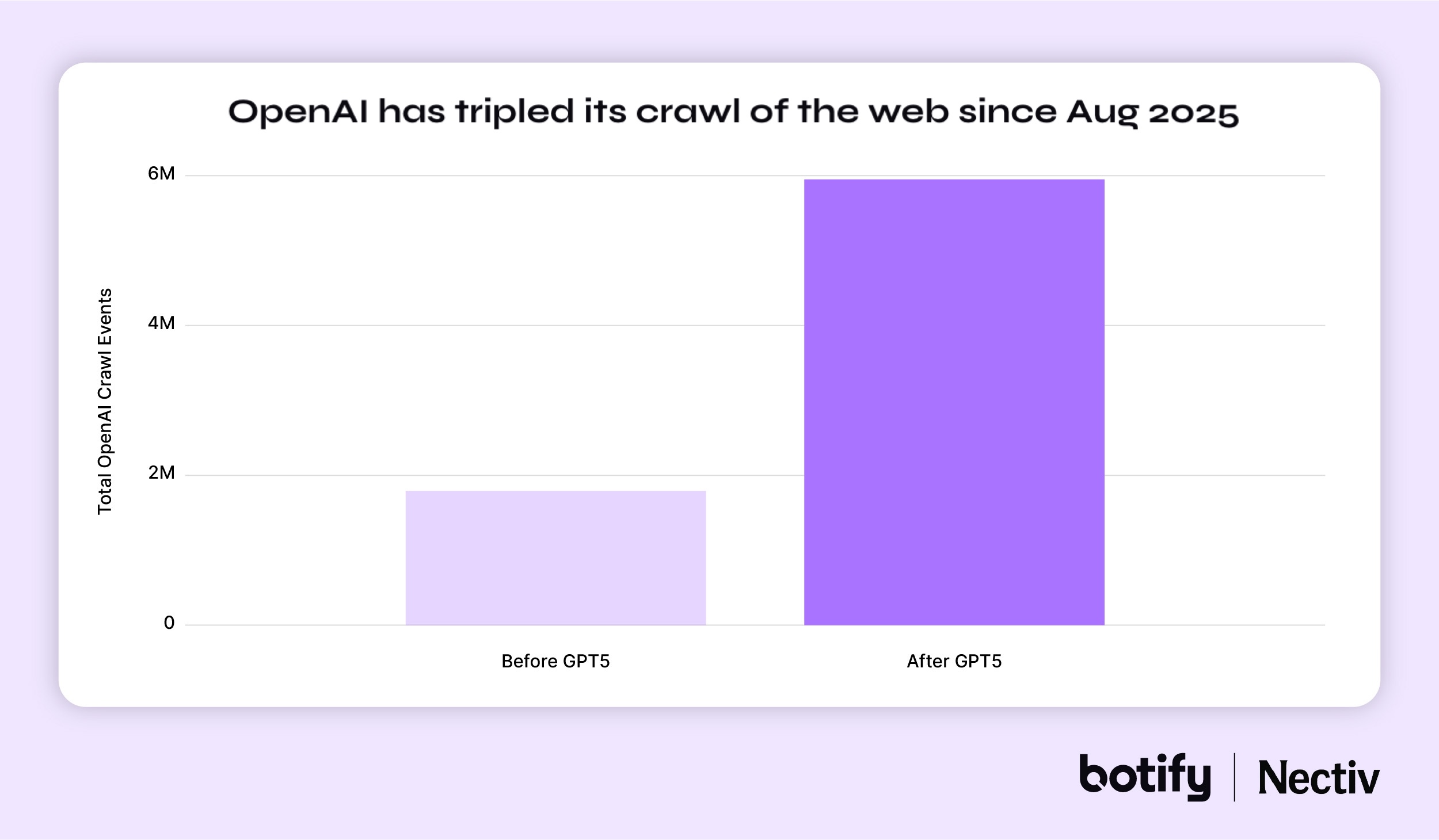
There's plenty of evidence this transition is already well underway. Our recent analysis of over 7 billion log files found that OpenAI has roughly tripled its web crawling activity since August 2025. Its search bot, OAI-SearchBot, increased activity by 3.5x over the same period. Separately, Botify data shows AI bot traffic to retail sites grew 5.4x during 2025. This means the machines are already visiting your site. Whether they find anything useful when they arrive is a different matter.
What's stopping brands from being found in AI
Despite how quickly agentic commerce is moving, most enterprise brands aren't well positioned for it. A few common problems keep surfacing:
AI systems can't see you if you're not speaking their language
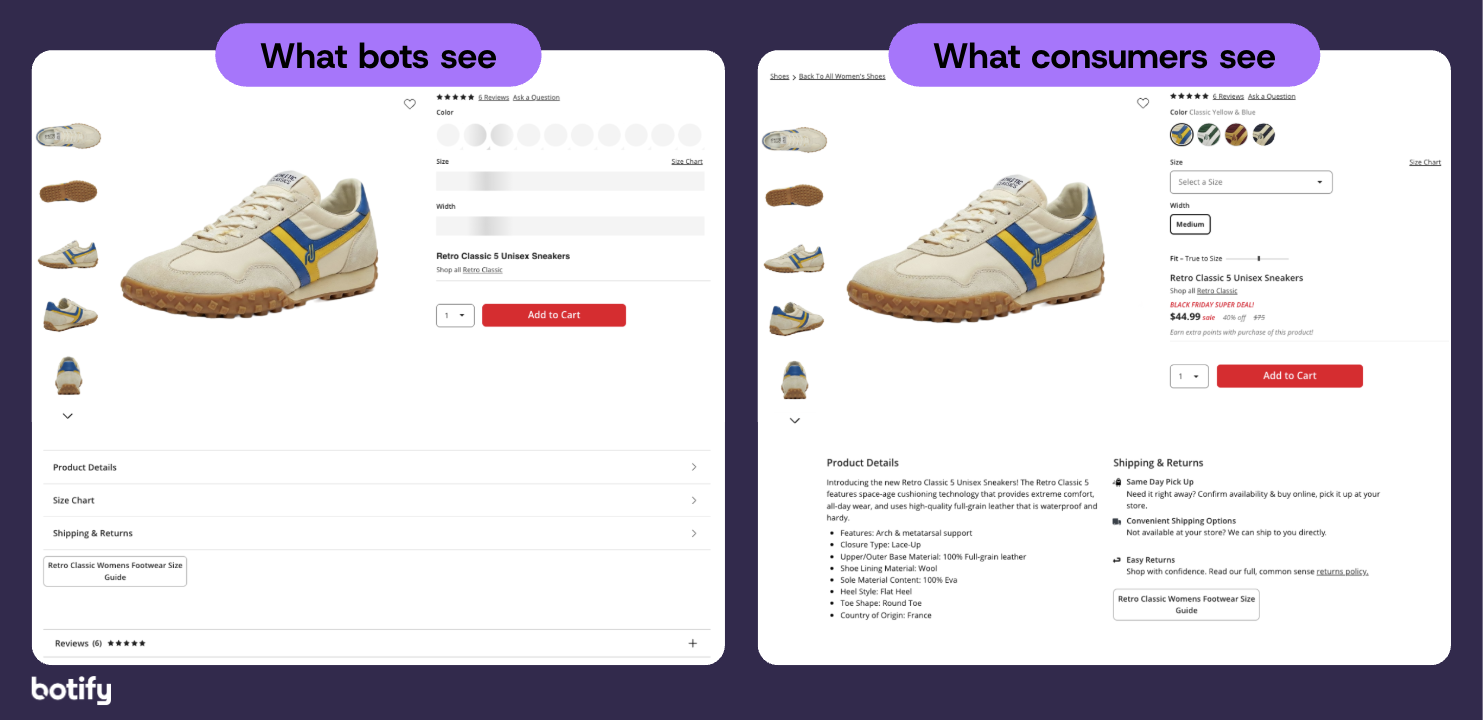
Investment in traditional SEO still matters, but it doesn’t automatically translate to visibility with AI agents. These systems don’t browse your site the way humans do. They rely on structured data to determine what’s relevant long before a consumer ever interacts with your brand. If your product information isn't available in formats they can process, you're effectively invisible, regardless of how well you rank in Google.
Product catalogs weren't designed for AI
Most existing product feeds and catalogs were built for Google Shopping or paid media channels. They cover the basics, like title, price, image, description, etc., but they're thin on the contextual signals AI agents rely on to make recommendations, such as customer reviews, Q&As, detailed product specifications, or customer use cases. Without that depth, AI systems don't have the confidence or data to surface your products.
There's not a simple way to tell what's working
New protocols and standards are being adopted quickly, and brands have almost no visibility into whether their data is being consumed by AI systems or how it's performing once it gets there. Most companies can't explain why they're absent from an AI-generated product recommendation, much less figure out what to change.
The result: Lost brand control, lost market share, and lost revenue
These challenges can lead to undesirable outcomes, if not addressed:
- Loss of brand control: When product discovery happens inside an AI chat window rather than on your website, you have limited influence over how your products get described, which features get highlighted, or how your brand comes across. If the AI system is working from incomplete or third-party data, the representation could be off and you might not even know it's happening.
- Loss of market share: Competitors who prioritize AI readiness and make it easy for AI systems to find and use their product content will be the ones that show up. When consumers are looking for products, they’ll find those competitors, not you.
- Loss of revenue: Agentic commerce is an emerging revenue channel; as it grows, your visibility in AI systems will become more and more consequential. If you don’t show up when consumers search, you can’t make the sale.
What being AI-ready means in practice
Think of it this way: you invest heavily in UX to deliver a great experience for human visitors. Being AI-ready means bringing that same level of intentionality to the experience you deliver to AI agents.
These systems are becoming a primary path to your products, and they have their own set of requirements for what makes a visit productive:
Content needs to be machine-readable
AI agents don't always (and sometimes can’t) render JavaScript-heavy pages the way a browser does. They need clean, well-structured content they can parse quickly. If your product pages are locked behind rendering barriers like JS, or if they load slowly, bots will see an incomplete version of what you actually offer. Or worse, miss it entirely.
Your data needs context
A feed with a title, price, and image is table stakes. AI agents evaluate products more like a well-informed shopper would — they want reviews, specifications, use cases, competitive differentiators. Feeds that lack this kind of contextual richness make it harder for AI systems to recommend with any real conviction.
Accuracy is table-stakes
Issues like incorrect pricing, out-of-stock items showing as available, or inconsistent descriptions across channels erode an AI agent's trust in your data. A human shopper might overlook small discrepancies and come back to you later, but an agent evaluating hundreds of sources will simply deprioritize yours.
The protocols that will define agentic commerce
The infrastructure for agentic commerce is being built in real time through a few protocols worth tracking:
- OpenAI's Agentic Commerce Protocol (ACP) defines how AI agents interact with commerce platforms — the structured formats product data needs to follow for agents to discover, evaluate, and recommend products reliably.
- Google's Universal Commerce Protocol (UCP) focuses on transactions. It creates a standardized framework for how AI-driven purchases get authorized, processed, and fulfilled, including payment handling and post-purchase order management.
- WebMCP (Web Model Context Protocol) addresses a different piece of the puzzle. Co-developed with Microsoft engineers and currently in early preview in Chrome, WebMCP helps websites declare what actions an AI agent can take on the site. If structured data like Schema.org describes what things are on your site, WebMCP describes what an agent can do there. In practice, WebMCP handles the interaction and UCP handles the transaction.
These protocols are evolving fast and compliance requirements will, too. Brands that start building against these standards now will have a meaningful head start, both in terms of technical readiness and the institutional knowledge that comes from testing and learning early.
The push vs. pull of AI commerce
One concept worth internalizing is the difference between "push" and "pull" when it comes to AI visibility. Most brands are only doing one of these well, and that creates a lopsided picture for AI systems trying to understand their catalog.
Content that AI systems pick up by crawling your website, such as product pages, category pages, blog content, and reviews, are the pull side. It's the familiar model: you publish, bots crawl, and the information enters the AI system's knowledge base. Optimizing for pull means making sure your site is technically sound, that AI crawlers can access and render your pages, and that your content carries enough depth to be genuinely useful.
The structured data you send directly to AI platforms is the push. Put simply, this is the information that doesn't require a crawl. For example, pushing product feeds directly to AI models like ChatGPT ensures they can access to your complete, current catalog in the exact formats they need, without waiting on those agents to find and extract the data themselves.
AgenticCatalog: Your best solution for AI-ready product feeds
AI platforms need to be able to both pull relevant content from your site through crawls, as well as receive updated catalog data from you directly, or “pushed” data, in order to optimize visibility. With the launch of Botify’s AgenticCatalog, we’re proud to be the only solution that solves for both the push and the pull. AgenticCatalog provides this proactive delivery of information by turning your existing product catalog into AI-optimized feeds that get your products in front of AI agents in the formats they actually need.
Currently in beta, AgenticCatalog ingests your existing product feed (from Google Merchant Center, a PIM, or an in-house system) and enriches it with the contextual signals AI systems need to evaluate and recommend products. That enrichment draws on Botify's robust site crawl intelligence, pulling in reviews, Q&A content, detailed product attributes, and other signals that most feeds lack. It then generates feeds compliant with emerging protocols like ACP and UCP, and delivers them directly to AI shopping platforms including ChatGPT and Google.
Don’t pay the price of waiting
The brands that will thrive in this new landscape are the ones treating AI readiness with the same seriousness they've brought to every other search update, from the rise of e-commerce itself, to mobile, to social media.
There's a natural temptation to watch the space for a while before committing resources. But the trajectory of the data makes a strong case for moving now. AI crawl volumes are surging, consumers are already shopping through AI assistants, protocols are being codified, and the brands investing early are building useful feedback loops, learning what drives AI visibility, refining their data, and establishing themselves as reliable sources that agents return to.
Ready to make your brand AI-ready? Request a demo of Botify’s AgenticCatalog to see how automated, AI-optimized product feeds can help your products get found, recommended, and selected wherever agentic commerce is happening.


.svg)


.svg)
