

.svg)


Despite all the changes we’ve seen in the SERPs over the years, when it comes to traditional search, brands have had reliable data sources to understand their performance. Between Google Search Console, Google Analytics, and data from third-party rank tracking tools, search professionals could put together the puzzle pieces of who is searching for them and where.
But when it comes to measuring visibility in AI search, those same data sources fall short. They can't see inside the “black box” of LLMs, and they can’t tell you why a chat bot chose one source over another when answering a prompt.
In lieu of third-party tools, one of the most reliable data sources your brand has for AI search insights is your log file data.

That’s because AI bot visits have increased 4.5x over 2025, with sites now seeing an average of 112 AI bot crawls for every single human visit.
"ChatGPT user crawl data is the closest thing to real impression data that we have from ChatGPT," says Frank Vitovitch, Botify’s VP of Solutions Consulting. "If you're not looking at this right now, you're ignoring the most concrete real data you could have."
In this post, we’ll discuss what your log data can tell you about your AI search visibility, and how to easily pull and analyze it.
Which bots are hitting your site, and why?
Not all AI bots serve the same purpose, and understanding what each one does helps you interpret what their presence means for your visibility.
Consider ChatGPT-User. This crawler is triggered when actual humans interact with ChatGPT and ask questions that it can’t pull from its own training data. When you see ChatGPT-User in your logs hitting specific pages, what you have is a useful proxy for impressions in ChatGPT, showing that your site was considered as a potential source for answering real user queries.
While this doesn’t tell you whether you were ultimately cited in the response, it confirms that your content is at least found and considered, and that’s something no other data source can definitively prove.
What does your bot activity tell you?
Each AI bot has a different purpose. Some crawl for real-time retrieval like ChatGPT-User, others crawl for training data, and still others for indexing and classification, similar to GoogleBot or BingBot. Each bot's behavior pattern in your logs provides proof points about how AI systems perceive and value your content, including:
1. If your site is discoverable:
If bots consistently access certain sections of your site but ignore others, that’s a signal about what content is most relevant and/or easily discoverable.
2. If your site structure is easy to navigate:
Bots that only scratch the surface of your site may mean problems with crawl budget allocation, a lack of internal linking, or complicated site architecture. If some of your valuable content exists deep in your site structure and shows no bot activity, you've identified a technical barrier. Those that explore extensively indicate strong site health and strong connectivity between relevant pieces of content.
3. If your optimizations are working:
Changes in bot behavior over time reveal whether your optimization efforts are working. Increased crawl frequency, deeper site penetration, or access to previously ignored content sections all indicate improving AI search positioning, long before you might see results in citations or traffic.
What can you do with the insights from your log data?
Insights are only valuable if they’re actionable, and log data analysis can support strategic initiatives for AI search success, such as:
Building a comprehensive AI governance plan:
Some organizations need to protect sensitive information or comply with regulatory requirements. Your logs reveal what's currently being accessed and by which bots, allowing you to make informed decisions about blocking certain bots from specific areas, or conversely, ensuring valuable content isn't inadvertently blocked. For more information on building a governance plan, you can review our guide.
Addressing optimization gaps and opportunities:
Compare bot activity against your strategic priorities. Do you want AI systems to find information that they currently aren't reaching? Maybe bots aren't crawling deep enough into your site architecture to reach authoritative content you've invested in creating. These gaps are opportunities to adjust your technical SEO priorities, improve your internal linking, or rearrange your site structure to improve AI discoverability.
Measuring the effectiveness of your optimization efforts:
Remember that everything you're doing to optimize for traditional search engines remains important for AI search. ChatGPT, Perplexity, and other AI systems use traditional search APIs when retrieving information to answer queries in real time. Log data can provide feedback on these efforts. When you improve page speed, fix crawl errors, enhance internal linking, or optimize content structure, you should see corresponding changes in bot behavior.
Automatically retrieve and analyze your log data
While it may seem daunting to pull and review all your log files, luckily, you don’t have to do so manually. Botify Analytics tracks a large list of AI crawlers and will automatically collect your logs for you via LogAnalyzer, alerting you to any significant changes or issues by leveraging your historical data to surface trends and insights.
And with your log data available directly in Botify Assist, it’s easier than ever to conduct the analysis you need. Rather than wrestling with raw log files or waiting for technical reports, you can simply ask questions in Assist about which bots are visiting your site, what content they're accessing, how patterns have changed over time, and where opportunities exist.
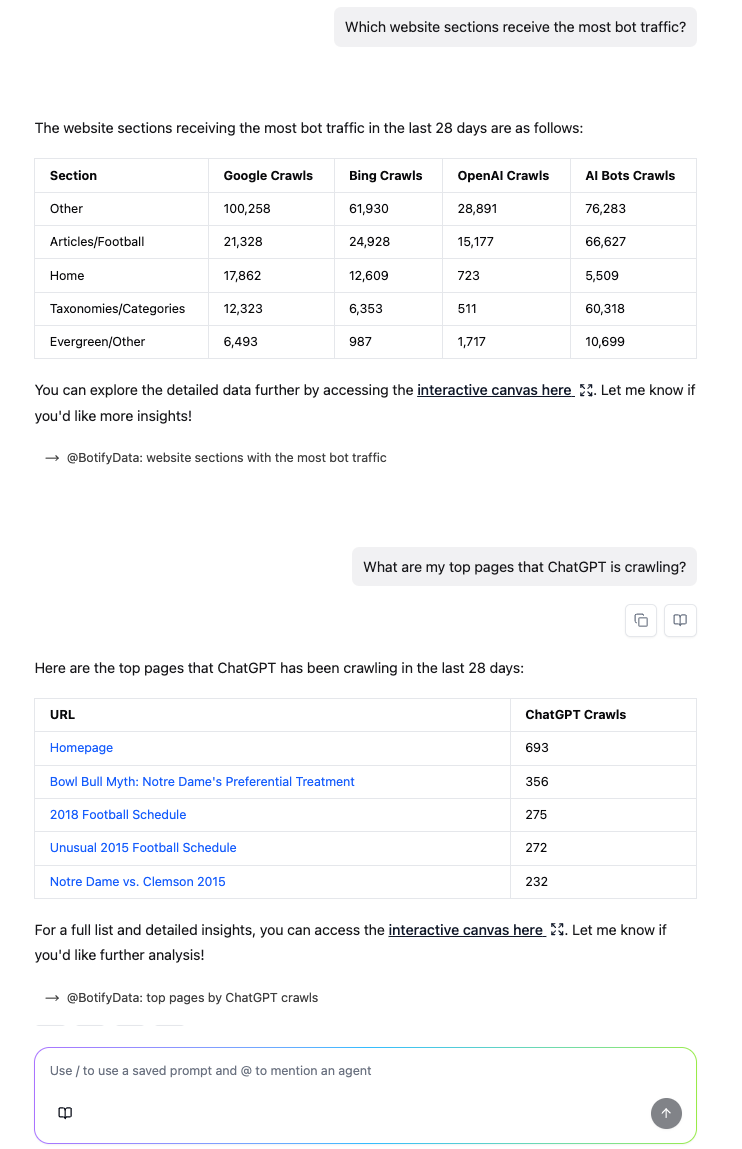
With your log data integrated with all your other connected data in Botify’s comprehensive ecosystem, you can correlate bot activity with content performance, technical issues, ranking changes, and business metrics all in one place. This means you can move from question to insight to action in minutes, making log analysis a practical part of regular optimization work instead of a specialized exercise that takes weeks to execute.
Find more on automatic log file collection and analysis in our resource: Tracking AI Bots on Your Site with Log File Analysis
Log files are your advantage in AI search analysis
With the right tools to access and understand them, log files can become your compass for navigating the rapidly evolving landscape of AI-driven information discovery by showing you how AI platforms are finding and using your content.


.svg)

.svg)
