

.svg)


Consumer behavior has been in flux ever since the dawn of online shopping, but AI is the biggest disruption yet to how consumers explore, discover, and decide what to buy.
Right now, there are three places your customers search for products, each with its own processes and rules:
- Traditional search via keywords (Google, Bing)
- AI-mediated discovery inside search platforms (Google AI Overviews and AI Mode, ChatGPT, Claude, Gemini, Perplexity, Copilot)
- Agent-led commerce running on emerging protocols (OpenAI/Stripe's Agentic Commerce Protocol, Google's Universal Commerce Protocol)
You might find yourself facing a crossroads: where is all of this going, and where should I focus my efforts now? After all, nobody wants to be a too-late adopter of AI search optimization, nor do you want to divert resources to activities that may not pay off. Today, we’ll look at where AI shopping is heading over the next three years and how to future-proof your brand.
Current trends & data
Consumers are using AI for shopping more and more
Our research found that 73% of consumers have already used AI for product discovery in the US, UK, and France, while 38% have used it for actual shopping tasks like comparisons and seeking recommendations. Along with that, Salesforce, analyzing the activity of more than 1.5 billion global shoppers across 89 countries, reported that AI and agents influenced 20% of all retail sales during the 2025 holiday season — roughly $262 billion in revenue.
AI-referred traffic is growing fast and converting better
Recently, Shopify found that AI-referred traffic converts 49% higher than organic traffic, and the orders are bigger, with 14% greater AOVs. Another study found that AI-referred traffic to retail sites grew 693% year over year during the 2025 holiday season, with continued 393% growth year over year in Q1 of 2026, 42% better conversion, and 37% higher revenue per visit.
AI agent traffic has exploded, vastly outweighing visitors
.png)
Earlier this year, we analyzed roughly 200 retail and e-commerce sites and found that AI bot traffic grew 5.4x in 2025. But where Google tends to result in one human visit to a website for every six agent visits, OpenAI had a visit-to-AI-traffic ratio of 1:198. This shows that AI systems are ingesting, validating, and comparing retail content inside their own interfaces far more than they send any visitors to retail sites. As more of the buyer journey occurs in AI platforms directly, there’s less reason to visit a website for the same information.
Most product content isn't machine-readable, which makes it customer-invisible
Most product content that gives vital context to shoppers — reviews, descriptions, variants, pricing, sales and deals, inventory status and more — are coded on the website in JavaScript. And the overwhelming majority of AI agents can’t see content coded in JavaScript at all. Therefore, a page can rank number one on Google, which renders some JavaScript, yet can remain a blank page to the AI agents powering discovery. If agents don’t know your product data exists, they can’t share it with consumers in chat, but they have to share something — and it could easily be your competitors.
Where discovery is going
We're currently at the doorstep of the newest era of search: the agentic era, in which discovery is mediated by AI systems that read, evaluate, synthesize, and increasingly act on a shopper's behalf.
What's changing is the interface between a shopper's intent and your products. Where a shopper once typed a query, skimmed through Google links, and clicked onto your own site, now, they ask a conversational question and get back an AI answer (a shortlist, a comparison, a recommendation), assembled by an AI system that already crawled your pages and ingested its feed, both before the shopper arrived and in real time during the conversation via Retrieval-Augmented Generation (RAG).
What to expect in the next 18 to 36 months
Near-term, the dominant dynamic is coexistence:
- Traditional search will continue to be a core channel as consumer adoption & protocols evolve
- AI Overviews will claim a larger share of the query mix
- LLM assistants will grow their share of the research phase
- Agentic checkout will begin as a series of high-profile pilots
Over the three-year horizon, however, the balance will weigh toward AI- and agent-mediated discovery as protocols standardize, agent technology advances, and shoppers accept conversational discovery as the default.
The retailers who win will be those whose product and content data is machine-readable, structured, and agent-accessible, and who deliver it to AI systems through the push-and-pull channels that give agents the data they need to make recommendations.
Start to rethink measurement for AI search
The other big (mindset) shift in AI-mediated discovery is measurement. Now, the metrics and reporting systems that have worked for two decades no longer cut it.
There are tangible consequences; one that matters especially to retail leaders is the "dark AI funnel.” This is real commercial influence that conventional dashboards can't capture, things that happen directly in the AI platforms — refining queries, clicking and comparing links, even checkout itself. The result is systematic underinvestment in a fast-growing, high-converting channel.
The answer is to build a new measurement layer for machine-mediated discovery:
- Visibility: The presence rate in percentages for how often your brand or URLs appear in AI-generated responses.
- Share of voice: How visible your brand is versus your competitors.
- Competitor trends: Benchmarking your visibility progress over time against your competitors.
- Citations: The percentage of AI-generated answers that reference and link to your brand.
- Average best position: How highly you’re cited, on average, when your domain is linked to in AI responses.
- Sentiment analysis: The proportion of answers that mention you positively, neutrally, or negatively.
- Platform visibility: Which models are surfacing your brand (ChatGPT, Claude, Gemini, etc.)
- Intent visibility: How visible your brand is across different customer journey intents like awareness, research, and decision.
Traditional metrics still matter for tracking your efficacy across traditional search channels, which still drive the most revenue today, and transactional intent still sends shoppers to retailer sites. But they won’t last through this next evolution of AI search, and it’s important that brands identify the right metrics to track before it’s too late and the data ship has sailed.
So, what does this mean for you?
Consider these two key factors:
- Much of your content is invisible to (and unusable by) AI platforms. This is a mission-critical fix. If agents can’t see your content, it will not appear in a channel with rapidly increasing influence over the customer journey. Failing to serve AI agents readable content leaves opportunity (and revenue) on the table, especially as we near the first Black Friday where AI sales could be significant.
- Both onsite and offsite agents can help you meet your customers at the moment of decision. On-site shopping assistants, like Walmart's Sparky or Amazon's Alexa+, operate inside your own experience; you control the data, the interface, and the relationship. In fact, Walmart CEO John Furner reports that users of the brand’s on-site agent Sparky see a +35% order value increase over non-users. Offsite agents, like ChatGPT, Gemini, Claude, Perplexity, and Copilot, operate outside your walls and decide whether and how your products appear. Winning means excelling at both: building great onsite AI experiences, and staying visible, accurate, and preferred inside offsite agents you don't control.
Your teams need to invest time and resources in the "place of decision" rather than "place of purchase"; it’s now a matter of focusing on where and how the buying decisions are made, rather than where the transaction is finalized.
Build your own Center of Excellence for AI search
The brands that lead the next decade of discovery won't treat AI search as a side project to organic search. They'll treat AI search and visibility as a business-critical function and build a Center of Excellence around it: a durable capability spanning marketing, merchandising, engineering, and data, one that treats visibility across every search surface as a managed, measured, revenue-bearing channel.
Master a two-channel strategy: Pull and Push
Everything starts here. Rather than focusing on a single channel, you should pursue optimizing the channels with universal utility; where no matter what the future holds, your efforts bear fruit in the form of product visibility and revenue. We refer to these channels as “push” and “pull,” referring to the two ways that retail data reaches AI systems.
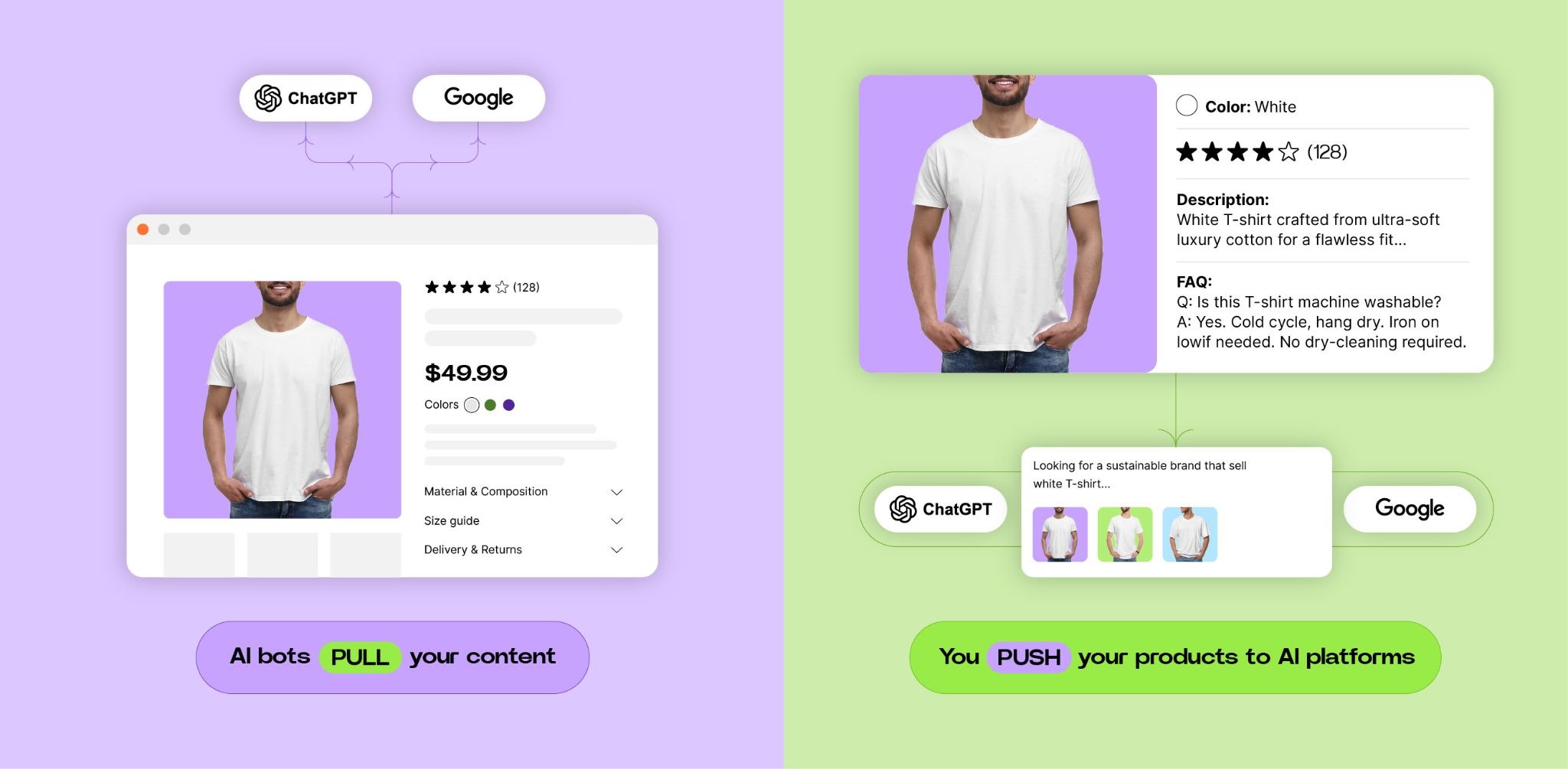
The “Pull” channel: become readable and crawlable
Imagine AI agents finding your product data on your website and then pulling it back to share with consumers on their own platforms — that’s the “pull” motion in AI search. This ensures every strategic page is fully visible to AI bots, structured with clean and consistent product data and free of the JavaScript-invisibility that hides your products from consumers. This highly actionable Pull Checklist provides an excellent starting point.
The “Push” channel: deliver AI-optimized catalogs directly
Now imagine those same agents leisurely lounging around, thumbing through a catalog of your product data that you handed them directly — that’s the “push” motion in AI search. Emerging agentic commerce protocols let retailers send structured, machine-optimized product data directly to AI platforms. The “push” motion is how you ensure your catalog is accurate, complete, and preferred inside agent experiences, while remaining the merchant of record. A partner to the Pull Checklist mentioned above, this “Push Checklist” can help you understand what to do to achieve AI-ready product feeds.
With Botify’s AgenticCatalog, you can deliver optimized product feeds directly into AI shopping experiences, ensuring your products are found, recommended, and purchased.
Why both, now? Timing is everything. Early presence in AI training and retrieval data builds an advantage that accrues over time: the more your structured content is ingested and cited, the more it becomes the trusted source AI systems return to. It's a flywheel, and flywheels reward whoever starts first. The window to build a durable lead is open now, before Holiday 2026, and before the protocols and their ranking behaviors standardize.
Building your Center of Excellence
After the pull-and-push strategy comes implementation. The best-in-class, first-to-market retail brands build five capabilities that work together:
- Unified agent analytics that provide a single source of truth for how every AI platform interacts with your site, so you can see what AI systems actually find and ground decisions in incontrovertible first-party data.
- Machine-readable content at scale that guarantees that your content, structured data, and product attributes are fully readable by AI crawlers across hundreds of millions of pages, closing the JavaScript-invisibility gap without waiting years for front-end rebuilds.
- AI-ready product feeds that deliver accurate, complete, machine-optimized catalog data directly to AI platforms.
- AI visibility measurement using updated metrics (like platform visibility, sentiment analysis, citation tracking, and more), operationalizing them and tracking them continuously.
- Treating crawlers and agents as a new kind of customer. The most valuable "shopper" you now have to win over is often a machine: the agent that decides what content is found and shared. Machine behavior is measurable and data-rich; brands that test, learn, iterate, and improve will have a leading edge. Run controlled experiments on rendering approaches, structured data formats, feed structures, and content depth, watch how bots and agents actually react, and feed that learning straight back into your strategy.
The future of AI shopping is opportunity for the taking
The shift to AI-mediated discovery is the fastest-growing channel you can start winning today, and the brands that make their products machine- readable and AI-ready now will become the trusted sources that agents return to again and again. Build your Center of Excellence, master the push-and-pull strategy, and meet your customers right where the buying decisions are made. Are you ready to future-proof your brand for the future of search? Schedule a meeting to see how we can help!


.svg)


.svg)
