

When someone searches for product recommendations in ChatGPT or Google AI Mode, the response they see is built from two different sources: the organic content it pulls from your website via crawls, and the structured product feeds you push to the platforms directly.
Feed data can get your product displayed in a shopping sidebar, carousel, or a final recommendation, in ways your website content alone cannot. If your product feed data is thin or outdated, you can have great organic content and still be invisible in the part of the AI shopping journey that actually results in a click.
But it can be tough to tell exactly how and where these sources show up in real conversations. Below, we break down two AI shopping experiences — Google AI Mode and ChatGPT — and show you exactly which content comes from which source.
Google AI Mode: Organic citations and product feed carousels

We prompted Google AI Mode for recommendations for "double chaise lounge sofa seats four".
The main written response is organic content pulled from Google's web index. You can identify it by a small citation icon at the end of each claim, functioning the same way a footnote does in a research paper. These link back to a specific source page, and they’re the first tell to remember for AI Mode: inline citations at the end of a sentence mean the web index generated that sentence, and it's crawling a specific page to back it up.
The "22 sites" panel to the right of the response is organic, too. It's a set of additional web results populating the same way a normal search result does, not populated from a shopping feed.

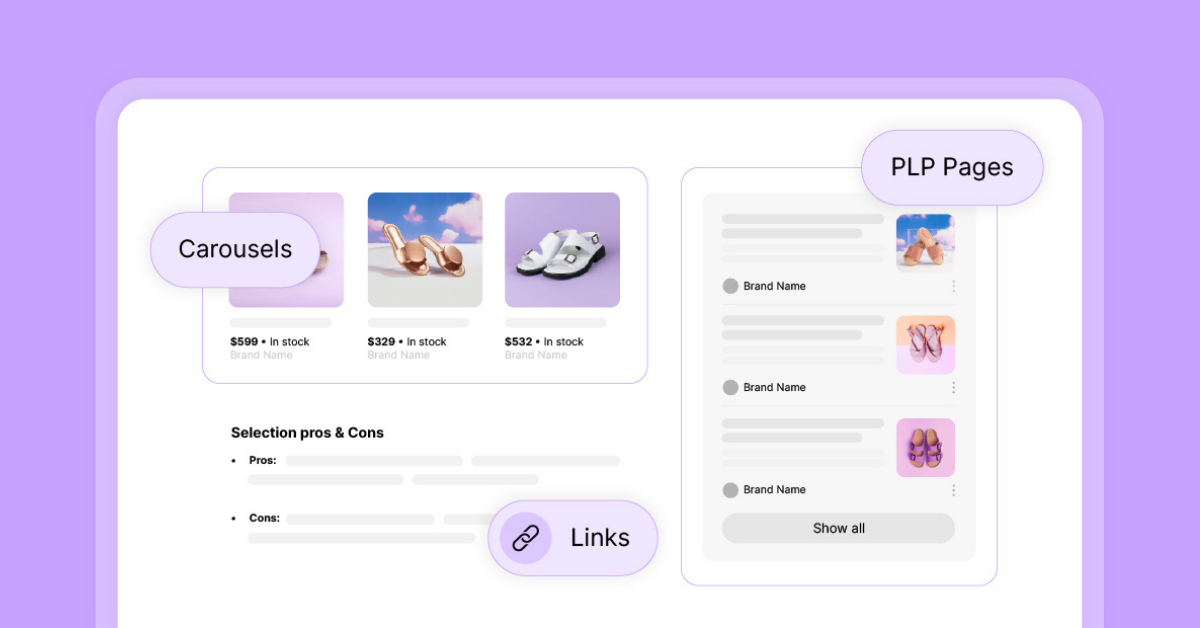
Now, further down the conversation, a horizontal carousel of four sofa images appears, each with a live price and stock status attached. These are shopping results sourced from Google's Shopping Graph and Merchant Center feed data. We know this because a feature showing live price and stock status is pulled from your product feed data, not organic index output. If a real-time price is displayed, a feed is behind it.
Google's own crawl behavior confirms it: our data shows that 61% of Google's crawl activity focuses on product detail pages, versus only 5% on product listing pages. Google is using those detail pages to verify the facts it already has from the Knowledge Graph and Merchant Center — is the price still accurate, is it still in stock, are reviews still solid — and is running those checks often. This doesn’t discount the need for your PLPs, which remain important for web indexing.
ChatGPT: Feed-heavy features with a few organic links
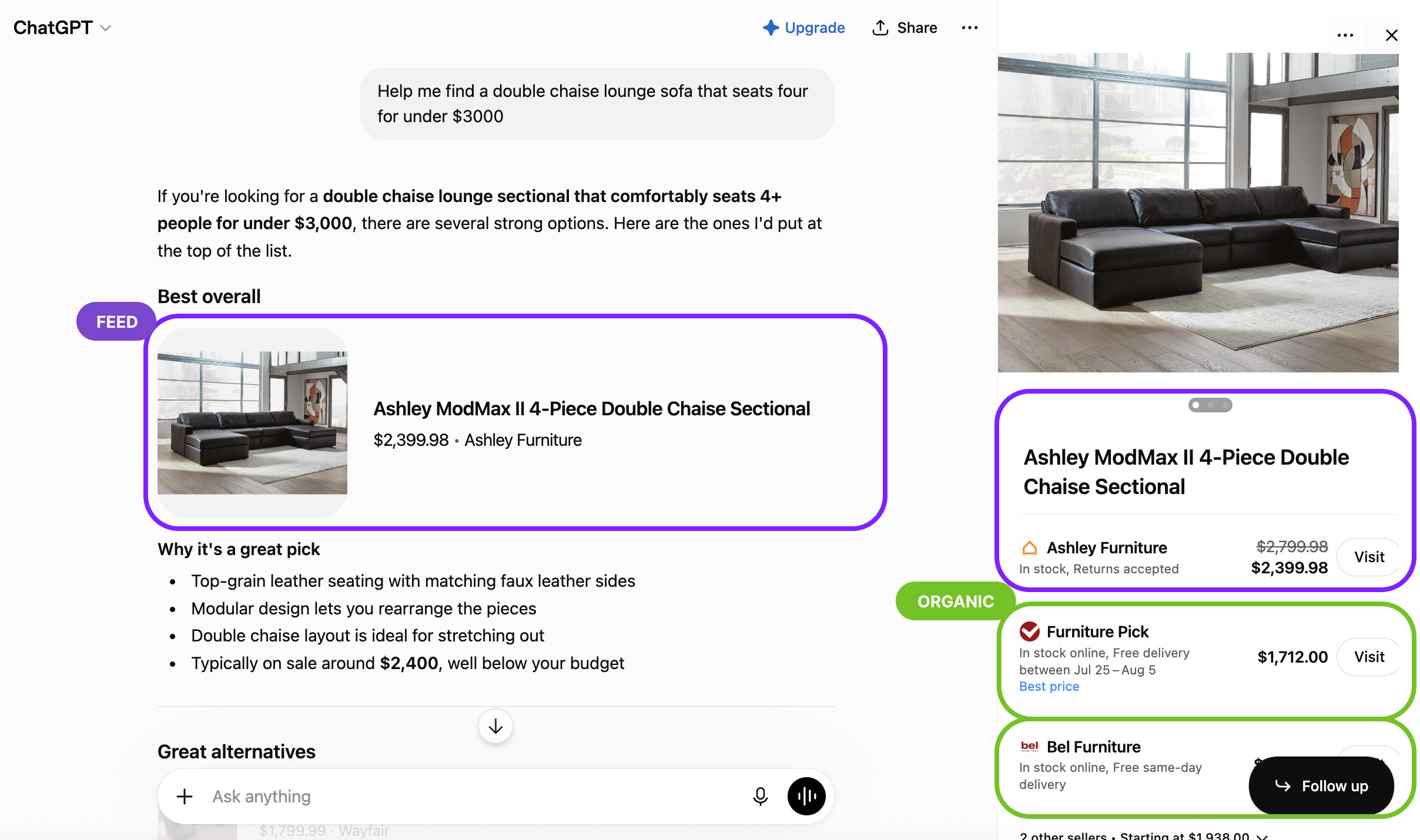
We asked ChatGPT to "Help me find a double chaise lounge sofa that seats four for under $3000".
The top recommendation, an Ashley ModMax II sectional, opens a detailed sidebar with a large lifestyle photo, a price with a strikethrough showing a markdown, in-stock and returns status, and a "Visit" button. The structured detail (current price vs. list price, return policy, stock) is the kind of data that comes from Merchant Center or a retailer feed, not from crawling a product page. A card with a large photo, a live price, and a "Visit" button is feed data.
It’s also worth noting that further down that same sidebar, two more listings appear as compact, single-line entries with a price and a "Visit" button, but no photo and no expanded description. These are organic. To tell, look at the URL these entries open. Feed-powered links often carry tracking parameters like “utm_source=feed” or similar tags.
In general, each time ChatGPT opens a product card that lists multiple merchants, the product card is coming from the feed data.

Further down the conversation, we get a "Worth considering from major retailers" section, a horizontal row of three product recommendations that are also feed data. Clicking into each one opens the same kind of sidebar treatment as the top pick: a large photo, the retailer name, live price, a "Visit" button, and an expanded "What to know" summary. A horizontal carousel format is a reliable sign that something is product feed data in ChatGPT, whether it's the single top pick or a secondary set of options.

Additional organic content in this conversation looks different. Rather than expanded shopping cards, they’re listed as plain bullet points. In "Best value from furniture stores," ChatGPT cites specific Living Spaces products and a Bob's Discount Furniture item, each tagged with a small source link next to them, the same pattern as a normal web search result.

Then to close out its recommendations, ChatGPT offers "My recommendations based on what you value," and here is where things get interesting. Most rows included in this section map back to something already shown: "Largest seating area" points to Bob's Luxe 147, the item that was just cited organically above. But the "Soft 'cloud couch' feel" row recommends "Latitude Run Kreindy", a product that never appeared anywhere earlier in the conversation as a citation or a card.
This is a chat mechanism worth keeping an eye on: feed data can get your product mentioned even if it’s not an exact match for the query, and it can introduce a product straight into the final recommendation.
This lines up with how OpenAI crawls. Similar to Google, 43% of OpenAI's crawl activity hits product detail pages, but in contrast, a notably larger 22% focuses on product listing pages. Where Google is mostly confirming what it already knows about your brand, OpenAI is mapping your taxonomy and category structure more broadly. OpenAI needs your PDP feed data to supplement what it can gather from your category pages, and it can't get the item-level detail it needs from PLPs by themselves.
Should you focus on product feeds or site content to earn AI recommendations?
To win recommendations in ChatGPT and Google AI mode, you really need to do both. Think of it this way: your site content earns AI citations; your feed earns carousels and product cards. If your product feed is clean and current but your category and listing pages are missing important attributes, OpenAI has nothing to map your catalog against. If your site content is strong but your feed is outdated or incomplete, Google can cite you, but it can't put your product in a real-time carousel or card where a shopper is clicking through to buy products.
Focus on keeping your feed data accurate, especially price, stock, and specs, because both platforms are checking it constantly. And keep investing in category, listing, and editorial pages, because that's the context a feed can’t display on its own.
Google and OpenAI aren't pulling from the same data in the same proportions, but the practical conclusion is the same for both: If you’re updating your product feed with new details like color, materials, FAQs, etc., remember to reflect those same updates on your product pages, and vice versa. A strategy that prioritizes both product feeds and website content is necessary to be found everywhere your customers are shopping.
Inspired to revamp your product feeds and earn more AI citations in Google and ChatGPT? Reach out for a demo of Agentic Catalog — we’d love to talk!