-min.png)

.svg)


As the kick-off to the holiday shopping season, Black Friday has always been an event by which retailers measure the success of the entire year. In 2025, the first year where AI-powered search and commerce agents will guide holiday shoppers through the entire consumer journey, that success will hinge on being found by AI and human searchers alike.
AI bots and agents already crawl e-commerce websites to refresh their knowledge of product pricing and availability, and during events like Black Friday or Cyber Monday — much like with human shoppers — that search activity spikes.
For marketing teams, the increase in AI traffic creates new opportunities to increase visibility across all the platforms consumers now use. Plus, the same steps that improve visibility in AI-driven search will also improve traditional search performance, meaning you don’t have to sacrifice traditional search visibility for your AI strategies.
And the good news is, with over a month to go before November 28, 2025, you still have plenty of time to capitalize.
AI crawling and shopping is rapidly increasing
Consumers are prompting AI platforms like ChatGPT with shopping queries more and more. According to a recent Bain & Company study, shopping prompts increased from 7.8% of all searches on ChatGPT in December of 2024 to 9.8% of all searches in June of this year. That’s a 25% increase in six months.
To answer those queries, the bots serving LLMs have to be able to find up-to-date product information. Botify data shows that AI bot traffic is increasing sharply. Across retail clients, crawls from AI bots rose from ~20 million per day in January 2025 to nearly 80 million daily year-to-date — a fourfold increase. At the same time, consumer behavior is shifting. Fewer clicks occur (1–5%), but the traffic that does reach brand websites is three times more engaged and twice as likely to convert. Together, these trends show why preparation matters. You may be receiving fewer visits overall, but those visits are more valuable.
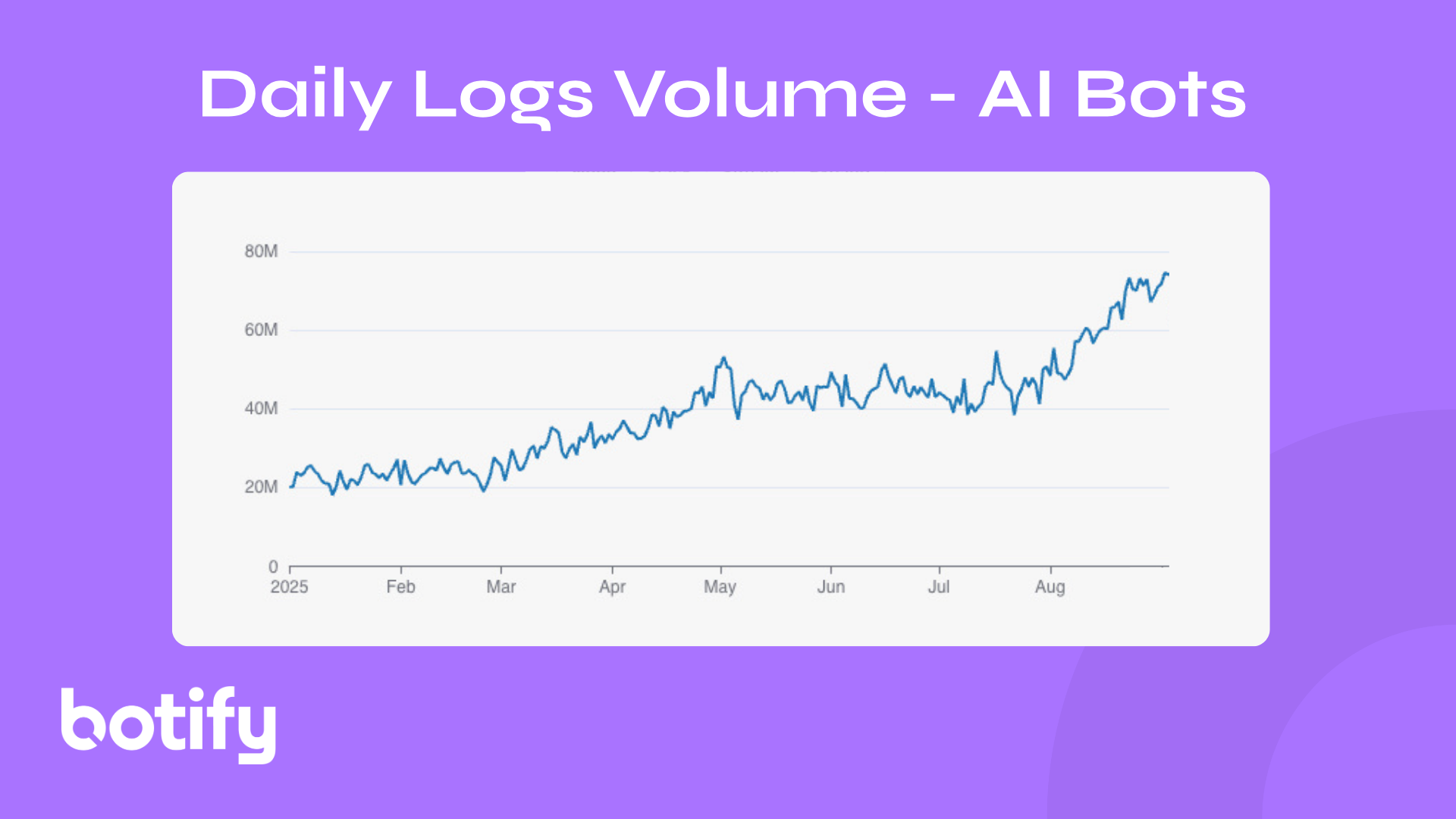
The expected crawling surge around Black Friday means that any visibility gaps will quickly translate into missed sales opportunities. If crawlers and agents cannot access or interpret your site’s content, those products may not appear in AI-driven recommendations, shopping guides, or search summaries. Competitors that make their content easily crawlable and aligned with seasonal demand will then have the advantage.
An example of how this works in the real world:
A consumer asks an AI search platform, “who has the best Black Friday deals on organic cotton maxi dresses?” To answer, the AI triggers a bot to scan indexed data, find relevant pages, and match products to intent.
Retailer A and B offer similar dresses, but while Retailer A buries its product deep within category pages and relies heavily on unreadable JavaScript, Retailer B optimizes its site for deals and ensures bots see fully rendered content, like prices and reviews.
The AI bot easily surfaces Retailer B’s dress, delivers it instantly in chat, and the consumer converts. Meanwhile, Retailer A is left out of the conversation entirely.
For Black Friday 2025, consumers will likely increasingly delegate not just their research but their purchasing decisions to AI agents. Amazon’s “Buy-for-Me” feature, Walmart’s Sparky assistant, and OpenAI’s Shopify integration are early examples of these models in action.
Seasonal search optimization in practice
If your brand normally approaches Black Friday with a single lever — paid ads — you’re not alone. Paid search is a popular strategy, but while ads may dominate attention on the SERPs for a short period, they come at a high cost. As bids increase for prime real estate during the busiest shopping weeks of the year, your profit margins shrink.
Historically, organic optimizations have been overlooked during peak periods because they’re assumed to take too long to deliver results. Yet our data and client experiences suggest otherwise.
When a brand removes technical barriers and updates its site with seasonal content, both search engines and AI crawlers respond quickly. Targeted updates applied even in the weeks before Black Friday have produced measurable improvements in crawl coverage, search visibility, and ultimately, revenue.
For example, one electronics retailer was facing year-over-year declines as Black Friday approached. Their challenge was not a lack of inventory or offers, but rather a lack of discoverability. Their critical product pages were invisible to crawlers. To fix this, they leveraged Botify SpeedWorkers to ensure every revenue-driving page was fully rendered and accessible to bots. The impact was immediate. Google explored twice as many pages as the previous year, non-branded traffic grew by more than 3% year-over-year, producing 4 million retained clicks and $20M in revenue, and Bing traffic increased by 30%, generating $6M more revenue.
GAME, a UK-based video game retailer, faced a different problem. Their e-commerce site was burdened with technical issues, and engineering bottlenecks delayed even simple optimizations. Ahead of the 2023 holiday season, they turned to Botify PageWorkers to update internal linking, reduce crawl depth, and surface their most valuable product pages without relying on developers to deploy needed updates.
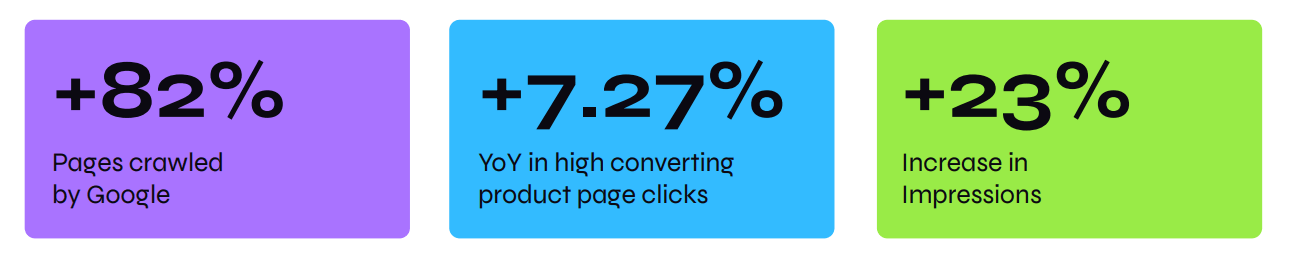
By doing so, they increased Google crawl coverage from 18.4% of pages to 82%. Organic clicks to high-converting product pages grew 7.27% year-over-year, impressions rose 23%, and organic revenue climbed an incredible 146%.
These stories underline a simple point: The ability to act quickly can help your brand gain visibility exactly when demand is highest.
Your AI search visibility strategy for Black Friday 2025
1. Ensure crawler accessibility
When a crawler encounters a page that requires heavy JavaScript execution, like many product description pages, the result is often missing or incomplete indexation of that information. During peak shopping periods, that will mean the difference between a product being found or ignored.
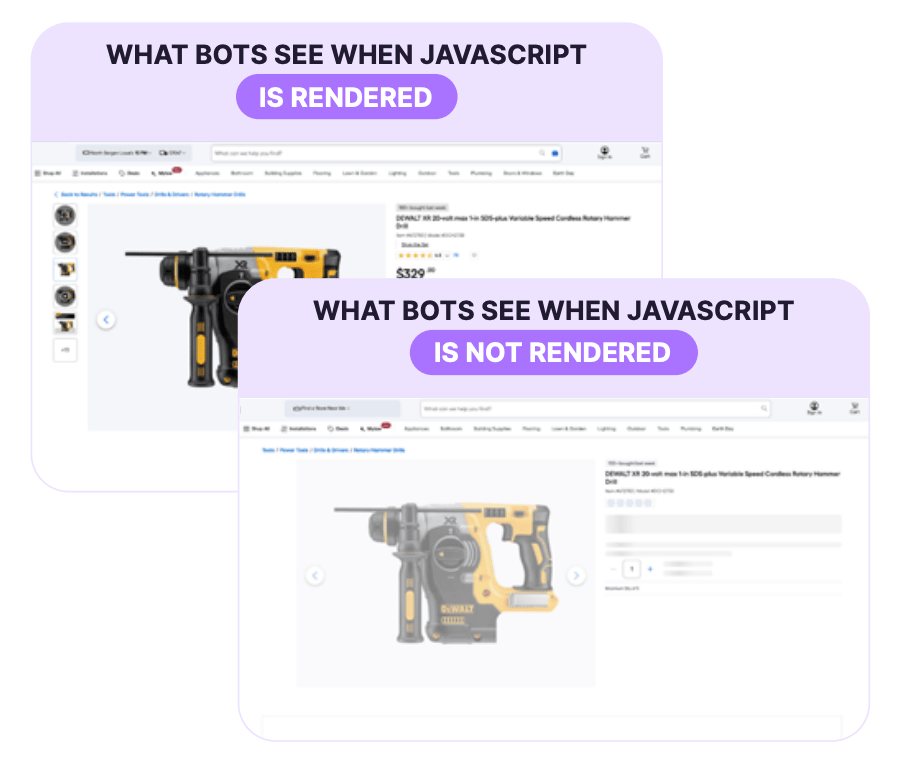
Large e-commerce sites will need help from tools to optimize crawl accessibility at scale. Botify SpeedWorkers does this by serving fully rendered HTML versions of your pages directly to bots. This ensures your product descriptions and availability indicators are always visible, so that during Black Friday, when consumers ask AI assistants for “the best deal on 4K TVs” or “in-stock gaming consoles,” your products get served up in the suggestions.
Pro tip: Most product reviews are provided by third-party services via JavaScript. If they aren’t pre-rendered and served to AI bots, you risk that goldmine of consumer input being completely missed in AI search.
2. Implement seasonal updates at scale
Because product details like promotional pricing and availability can change quickly, especially during seasonal sales, brands must be agile to stay visible. And for larger sites, without the ability to update this information at scale, you risk showing outdated offers to consumers using both traditional and AI search, or missing them entirely.
To remove dependence on engineering backlogs to push needed updates, Botify PageWorkers allows your team in charge of search to deploy changes, including pricing and schema updates, instantly across thousands of pages. Updates can even be scheduled in advance, pushed live at the start of Black Friday, and rolled back after the event ends.
3. Prioritize the indexation of high-value content
Large e-commerce sites contain millions of pages. During Black Friday, only a fraction of these likely matter for holiday revenue. If crawlers focus on outdated or low-value pages, priority seasonal content may remain unseen.
Marketing teams can highlight high-converting product detail pages and seasonal landing pages while reducing exposure of irrelevant or outdated content by using SmartIndex to automate and improve their indexation, thus increasing the chances that the products consumers are most likely to buy are the ones surfaced by both traditional and AI search.
4. Align metadata and descriptions with consumer intent
Consumers do not search generically during Black Friday; they use specific, seasonal language: “Black Friday laptop deals,” “holiday gaming bundles,” “delivery before Christmas”, etc. AI platforms will rely on contextual clues, including metadata such as page titles and descriptions, to best answer these queries.
To update this data during promotional periods, leverage SmartContent to generate unique, data-informed, engaging copy and then deploy that copy quickly and efficiently through PageWorkers, reflecting content that attracts holiday shoppers across the site immediately.
Prepare now to maximize end-of-year gains
The combined effect of these actions is measurable:
- More complete crawl coverage during promotional retail events
- Improved representation of seasonal offers in both AI and traditional search results
- Faster deployment of promotional content without engineering bottlenecks
- Better alignment between what consumers search for and what crawlers discover
- A reduction in reliance on paid ads as the sole visibility channel
Black Friday 2025 will be the first large-scale test of how consumers adopt AI-driven search and shopping tools. Brands that prepare now will not only capture short-term seasonal revenue but also establish a foundation for future visibility in the expanding AI-search ecosystem.
The evidence from past seasons is clear: technical accessibility, scalable updates, focused indexing, and aligned metadata produce measurable gains in both traffic and revenue. Retailers who take these steps will enter the holiday season with confidence that their products are discoverable, accurate, and ready to be found wherever consumers are searching. Learn more in our free ebook, Holiday 2025: AI Search as Your Competitive Edge.
.png)

.svg)
.svg)
