

.svg)


In this era of agentic commerce, AI agents don’t just influence purchase decisions — they make them.
With Black Friday and the holidays fast approaching, brands need to keep pace. Your consumers will be using ChatGPT and Alexa to do more than compare products: they want AI to go one step further, actually buying the best products on their behalf. This holiday season will set the stage for how we can expect e-commerce to evolve alongside AI and agentic technology in every season to come.
Today and in the future, one question will define which brands stay ahead of the competition: Does the model know about you?
What is agentic commerce?
Agentic commerce is when autonomous agents built on large language models (LLMs) act on behalf of a consumer to discover, evaluate, and purchase products or services. This combines current AI search capabilities with new advancements in agentic technology. E-commerce giants are already developing agentic commerce solutions: Amazon’s “Buy-for-Me” feature announced in April follows at the heels of their Rufus AI shopping assistant debut last year and the introduction of Alexa+, and this June Walmart announced Sparky, an AI assistant that “synthesizes reviews, offers occasion-based recommendations, and helps customers plan, compare and purchase with confidence.” Other major retailers and AI platforms, including ChatGPT and Perplexity, are actively developing agentic commerce solutions as well.
AI is already shaping the customer journey
AI search platforms like ChatGPT and Perplexity condense search into a single, seamless experience where the journey happens without ever leaving the platform until it’s time to purchase. AI search is far more efficient than traditional search, where the data shows consumers spend around 1.25 minutes per session, conduct 1.2 queries, and 43% click through (with 42% of those bouncing.) Users spend about 23 seconds per session, conduct around 8 related queries, and only 1–5% click through. The result: fewer site visits, but the visitors who do arrive are three times more engaged and twice as likely to convert.
And early signs of agentic commerce are emerging: ChatGPT recently announced it wants to take a cut of purchases made through its platform rather than rely on ads. Meanwhile, OpenAI has partnered with Shopify to streamline in-platform transactions.
AI is going beyond just suggesting holiday present ideas for mom and dad. AI agents will buy them automatically. Throughout it all, the consumer is still in control, reviewing and approving purchases that are tailored to their past preferences, current needs, price comparisons, and even return history.
For brands, the takeaway is clear: AI is sitting between you and the consumer. As our own AI search expert AJ Ghergich says in his recent CommerceNext keynote, it can either be a bridge or a barrier, a helpful concierge or a gatekeeper.
The funnel is changing — our data confirms it
Consider this scenario:
- A consumer says: “Order my usual coffee beans, or something better if it’s on sale.”
- The AI agent checks historical purchases, compares reviews, weighs pricing and freshness, and submits the order while also tapping into its memory to personalize recommendations, creating a unique, tailor‑made purchase experience.
- No ad clicked. No email opened. No search results shown. Just prompt to purchase.
To show up in this journey, brands need a new kind of strategy, one that optimizes not just for human user experience but for agent experience (AX), the new UX. Your website and most important content isn’t just built for people to see, but for LLMs and agents to understand, recall, and act on.
Generative engine optimization (GEO) is the foundation
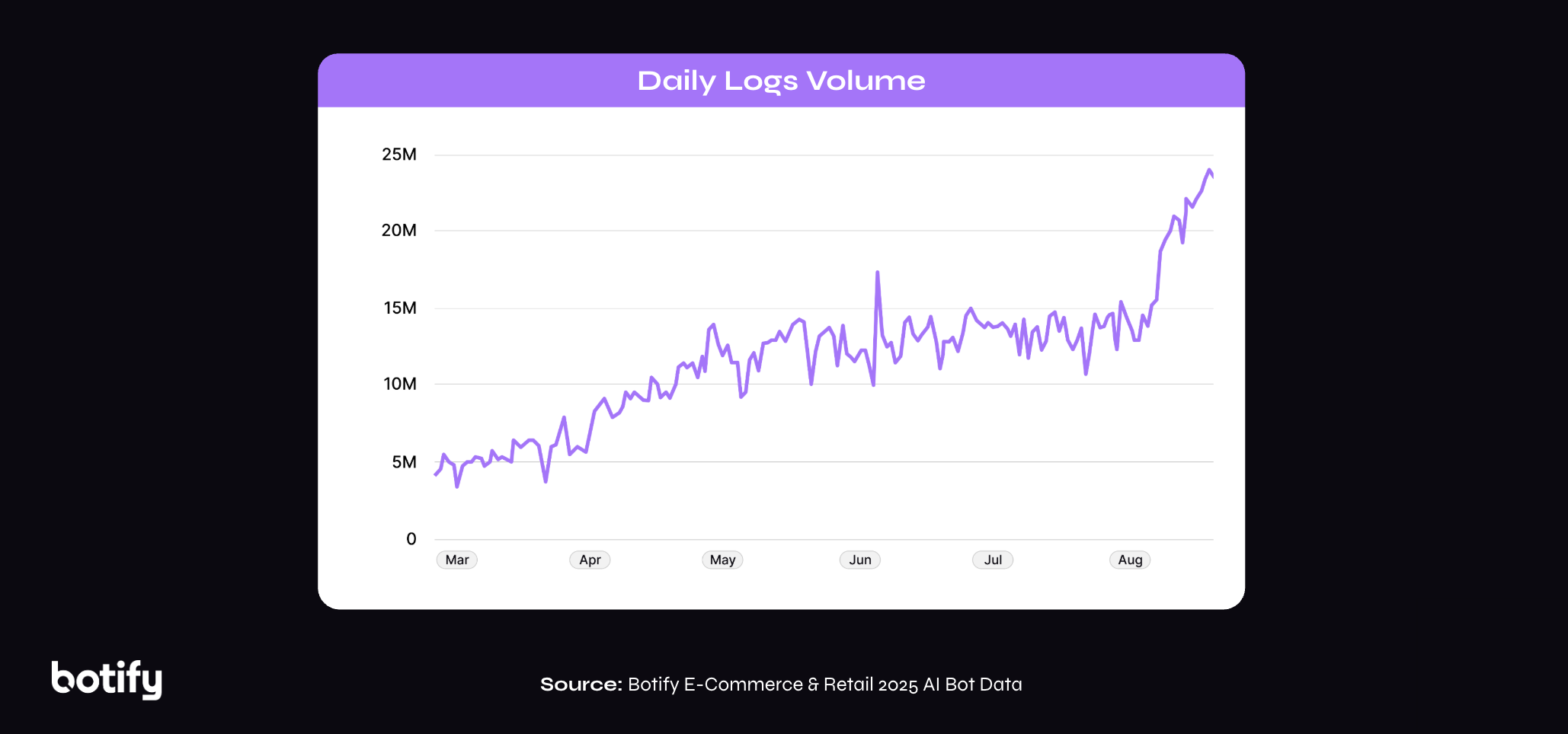
Agentic commerce starts with being found, and that begins with indexation. If your brand’s content isn’t visible to AI agents (i.e. structured, contextual, and optimized for generative AI engines), it won’t make the cut. Brand content is found by AI bots crawling websites and discovering content — and AI bots are crawling more than ever. Traffic from AI bots has more than x5 for our e-commerce and retail clients, increasing from 5M crawls per day in January 2025 to 25M per day in August.
This is where GEO becomes your growth engine:
- From ranking to referencing: Your brand needs to be referenced in responses on AI search platforms, not just visible on page one.
- From UX to LLM-readability: Your product data needs to be machine-readable and meaning-dense. Content needs to be enriched with context that gives each page meaning beyond the surface, like detailed product descriptions, specifications, and usage insights.
- From traffic to transactions: You need to optimize for how often the AI agent selects you.
At Botify, we’re already seeing brands rethink how they structure their product feeds, descriptions, FAQs, and metadata to serve multiple audiences: bots, agents, and consumers.
The rise of the autonomous shopper
Agentic commerce doesn’t mean consumers stop caring. It means they delegate. They’re embracing AI agents as a tool to streamline their purchasing journey. That means your brand memory inside the model matters more than ever, making AI the ultimate customer.
You need to be able to answer:
- Are we showing up in important search platforms?
- Is our information accurate and up to date?
- Can we measure and compare to competitors?
Winning today means adapting your search strategy. This includes aligning your site and content with AI intent, conducting a technical AI audit, and running an AI intent audit. It also means defining a strategic roadmap, setting clear rules for AI access to your content and rethinking how you measure success.
Don’t know where to start? We’re here to help. Schedule a consultation with our team of experts or identify your next steps in AI search via our Be Found Everywhere: Your AI Search Playbook.
.png)

.svg)

.svg)
