
.svg)


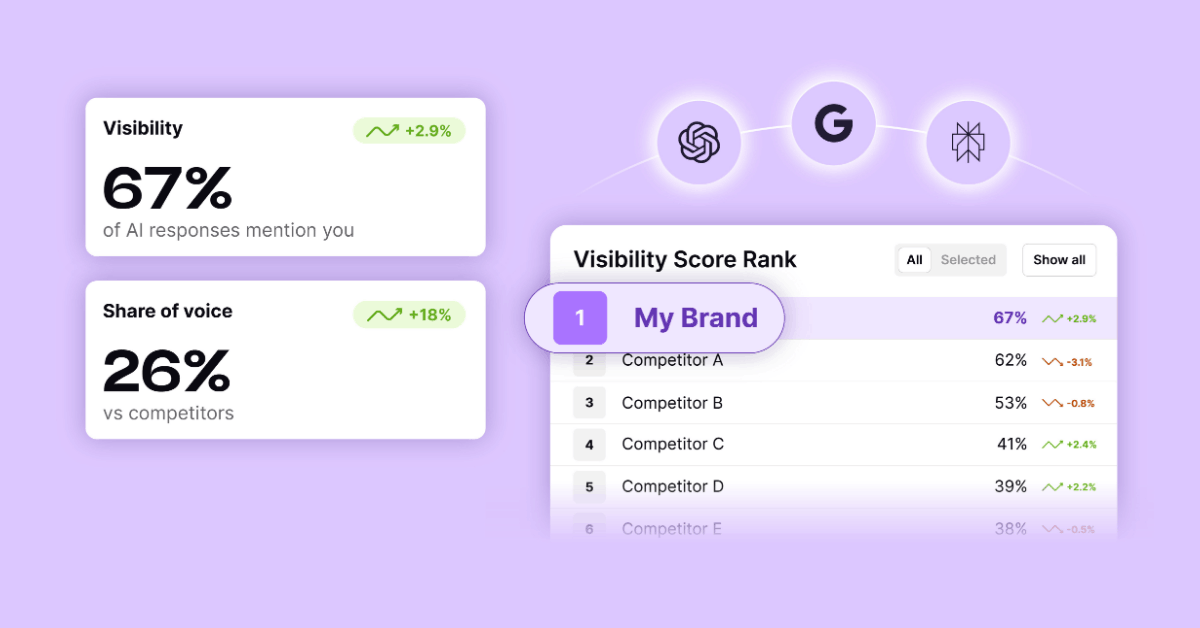
There's currently a disconnect between how brands are being told to measure their visibility in AI search and the realities of how AI search actually works.
You can't take old search ranking strategies, add "AI" to the title, and call it innovation. You've probably seen it already: tools that promise to show you how many prompts you appear in, what those prompts are, and where you "rank" in the outputs.
But that's not how AI search operates. ChatGPT, Perplexity, and even Google's AI Overviews aren’t just another version of the ten blue links, and your brand’s visibility within them can’t be measured the same way.
There’s comfort in predictability
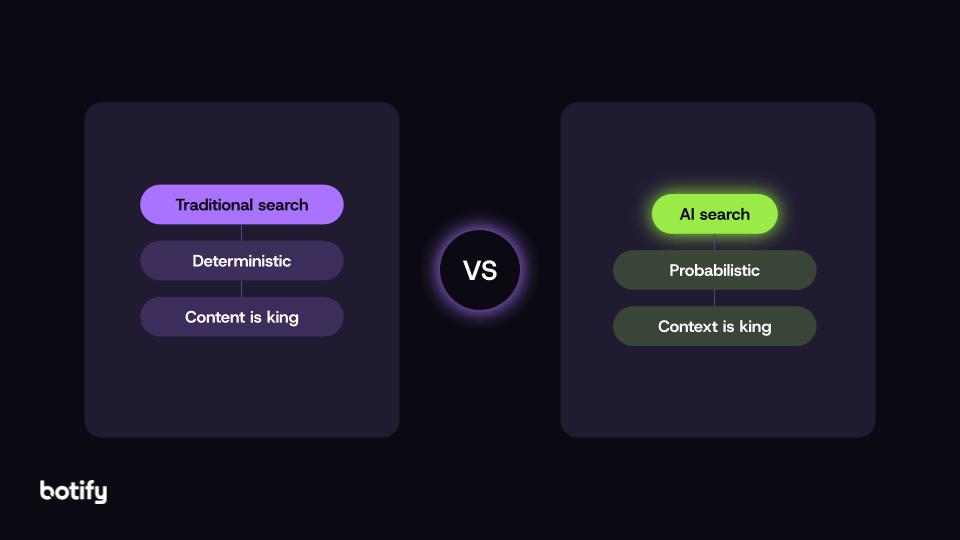
Traditional search is largely deterministic. If you do X, Y, and Z (for example, optimize your metadata, get trustworthy backlinks, publish authoritative content), you stand a good chance of ranking for your target queries. You can refresh the SERP for those queries and see, more or less, the same set of results in the same order.
Even as Google layered on featured snippets, knowledge panels, shopping suggestions, and other rich results, this underlying logic held. There was still a canonical set of results in a predictable order. You were either on the page or you weren't.
That determinism made measurement straightforward. Rank and keyword tracking rested on the simple idea that the system was stable enough that your SERP rank meant you were visible.
While that relative stability was comfortable, trying to apply the same logic to AI search won't offer you the same insights.

Generative AI isn’t predictable
Large language models (LLMs) that power AI search don't return ranked lists. They generate a unique response to each individual prompt. Those responses are:
- Stochastic: The same question asked twice may produce different answers due to probabilistic generation. The output is not fixed.
- Contextual: What the consumer asked earlier in the conversation shapes the answer they get to new prompts.
- Personalized: Over time, systems incorporate more signals about who the consumer is and what they prefer in their answers.
- Conversational: Instead of links, you get a narrative designed to answer the prompt like a human would.
If you try to force that behavior into a ranking framework ("We're the second brand mentioned in paragraph three!"), it may seem like you're measuring something statistically significant. But in reality, there is no single, universal result to determine your position in AI search, and thus no way to tie it to your actual visibility.
Prompt tracking: The illusion of control
On the surface, tracking whether and how your brand appears in responses to specific prompts over time feels like a tried and true methodology. But this type of measurement can't give you the full picture.
Why?
First, prompts aren't keywords.
They're natural language inputs within a conversation. The universe of prompts your customers might use is virtually infinite, expanding with every variation in phrasing and every follow-up question.
Second, your "rank" within an AI output fluctuates with every prompt.
The order of brands mentioned and how they're framed is part of a generative process, not a fixed, ranked index. It depends on training data, the AI's ability to pull real-time information, and the context of the conversation.
Third, as you add more prompts, your dataset becomes noisier, not clearer.
You end up drowning in granular, prompt-level “ranking” fluctuations that don't map cleanly to the actual customer experience.
The long tail is now a long story
In the world of keyword-based search, we talked about the long tail: millions of low-volume queries that, in aggregate, represented a huge opportunity. You could map and model that tail, cluster keywords, build content for each cluster, and gradually gain coverage.
AI is changing the shape of that long tail.
Where we once saw millions of discrete keyword variations, we now see fluid, evolving narratives. A customer doesn't show up to an AI tool with a static query. They show up with a problem they're working through with AI as a sounding board and advisor.
A prompt like: “I want to be healthier, but I'm overwhelmed and not sure how to get started” that generates recommendations may be followed up with another conversational comment, like "Maybe running would help, but I'm worried about my knees." Depending on the AI’s answer, the conversation could branch in myriad directions: What's a realistic way to start? What gear do I need? What are the best running trails for beginners in my area?
In AI search, consumers express their story through a dozen different prompts over the course of a conversation, none of which look like clean "keywords." But it's still one story. One intention.
You can spend your time trying to chase those prompts one by one, or you can lock onto something much more powerful: You already know every question your customers will ask AI.
Maybe not the exact words, but you know the intent behind them. You understand their pain points and the problems your brand can solve. All of that is visible in data you already have: search queries, reviews, support tickets, sales calls, and more.
The wording doesn't matter nearly as much as we've been trained to believe. AI is remarkably good at translating messy language into intent. The focus for brands shouldn’t be which prompts you rank for, but rather which consumer intentions and journeys you show up for.
Seeing the forest (intent) instead of the trees (prompts)
AI visibility should answer a very human question: When someone like your ideal customer turns to AI for help with a problem you can solve, do you show up in that story in a meaningful way?
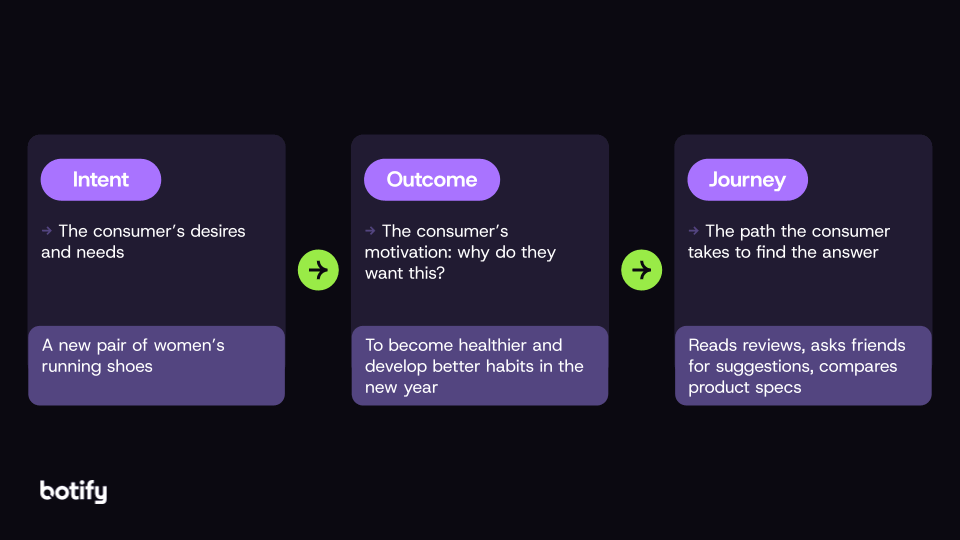
This question has three parts: intent, outcome, and journey.
Intent: Why they're asking
Intent is the underlying "why" behind a question. "I want to get heart-healthy" might show up as:
- "Beginner cardio workouts"
- "How to improve cardiovascular health without a gym"
- "Is walking enough to be heart healthy?"
These are all different prompts with the same intent. AI can see that, and your measurement should too.
For your brand, this means defining a small, honest set of core intents that matter. If you sell running shoes, "become heart-healthy," "start running," "return to running after injury," or "train for a race" might be some of them.
Outcome: What they want to do
Outcome is what the customer is actually trying to achieve. In our example above, "getting heart-healthy" is a state of being, and not something with one right answer. Maybe success looks like:
- Three cardio sessions a week
- No longer getting winded climbing stairs
- Feeling confident enough to call oneself "a runner"
Your products and content exist to move someone from intention to outcome. AI search is becoming the connective tissue across that gap. Measuring visibility successfully, then, means asking where in that arc your brand is present and where you’re absent.
Journey: How they get from here to there
Between intent and outcome is the messy middle. A customer might start at "How dangerous is high blood pressure?" and end at "best cushioned running shoes for beginners." The middle is full of questions about types of exercise, time constraints, injury fears, and motivation.
Today, most brands see it as a handful of disjointed keywords. AI sees that journey as a conversation. Mapping your AI visibility to intent requires your brand to reorient around this journey.
"This is the most customer-centric view of the journey of the user that we've ever had."
AJ Ghergich, Global VP of AI & Consulting Services at Botify
This isn't because generative AI is magical, but because, for the first time, we can watch the whole story instead of isolated queries.
Mapping visibility to intent
In practice, mapping visibility to intent looks less like an exported spreadsheet full of target keywords and more like a storyboard.
You can start by grouping what you see in AI responses, not by exact prompt, but by intent. Every time your brand appears in an answer, ask:
- What were they really trying to do when they asked this?
- Which of our core intentions does this align to?
- Where in the journey does this moment live? Are they just realizing they have a problem, actively exploring solutions, weighing brands, or ready to act?
Patterns will emerge quickly. You might find that you show up strongly once the conversation turns to "which running shoe to buy," but you're invisible when the customer is still deciding whether running is the right option for improving heart health at all. In that case, you're overrepresented at the "what to buy" stage and underrepresented at the "is this even for me?" stage.
With this intent visibility map, you can act on two things:
- Which consumer intents you always appear, sometimes, or barely appear in.
- Which stages of the journey you're missing from, even when you should be there.
Your legacy data is still relevant for mapping intent
Shifting how you measure your visibility in AI search doesn’t mean your legacy client data, keywords, or ranking insights are worthless.
Google Search Console data reveals what people are trying to accomplish. Customer support logs, on-site search terms, and sales call transcripts are all direct windows into real human questions and objectives. Similarly, keyword clusters can still tell you what your core intents are and how people talk about them. They can help you define the "forests" you want to see in your AI visibility data. Search performance data can tell you where you're already strong, which remains an important input, because AI systems still lean heavily on the open web when deciding whose content to surface.
To navigate the complex and often inconsistent world of generative AI search, you need to ground your analysis in the things you can reliably track. That’s why, when building our AI Visibility solution, Botify focused on three core metrics: visibility, citations, and sentiment. By analyzing the breadth of your readily available, first-party brand data across all these sources, AI Visibility can help your brand:
- Define the handful of consumer intents that matter most
- Use existing data to understand the journeys behind those intentions
- Map where, when, and how you appear in the journey within AI experiences
- Build content, products, and experiences that deserve to be surfaced as helpful answers along the way
Rather than focusing on how many prompts you appear in, AI Visibility can help you reveal how often you’re present and trusted when a specific kind of person is trying to reach a specific kind of outcome.
Focus on your customer’s unique story
AI search has given us something we've never had before: a live, qualitative view into how people think their way through problems and decisions. It has also exposed how brittle our keyword-era models really are.
We can respond by retrofitting the old playbook to force stochastic conversations into deterministic rankings, or we can accept that the game has changed, and with it, the metrics that matter.
The brands that win in this new landscape will be the ones that choose customer obsession over prompt obsession.
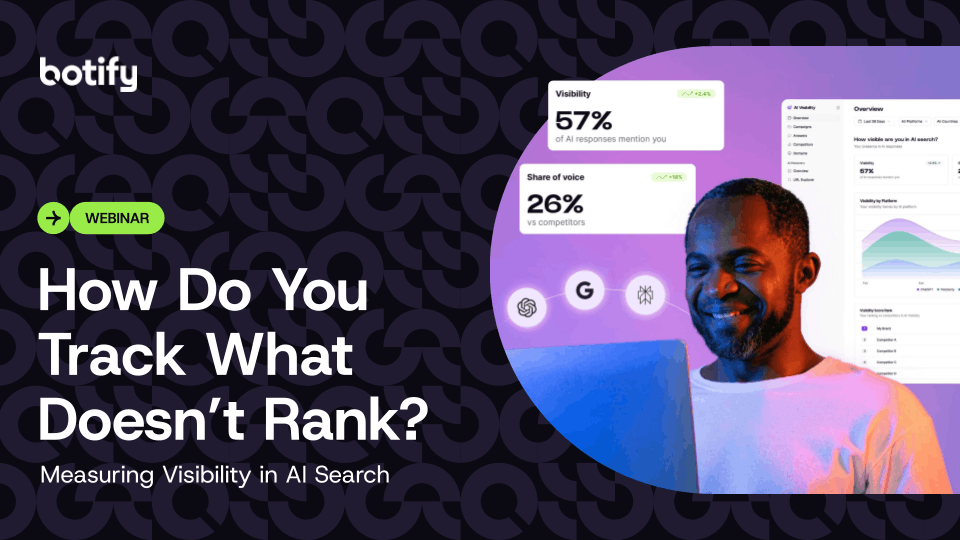
If you want to go deeper into AI visibility measurement, check out our recent webinar with Search Engine Journal: How Do You Track What Doesn’t Rank? Measuring Visibility in AI Search.


.svg)

.svg)
