
.svg)


When someone asks ChatGPT for “pants for a July wedding in California”, OpenAI pulls from two sources to recommend the right products: what they can find online and what brands provide through product feeds. That means if you want your products recommended in AI, you need to deliver a feed.
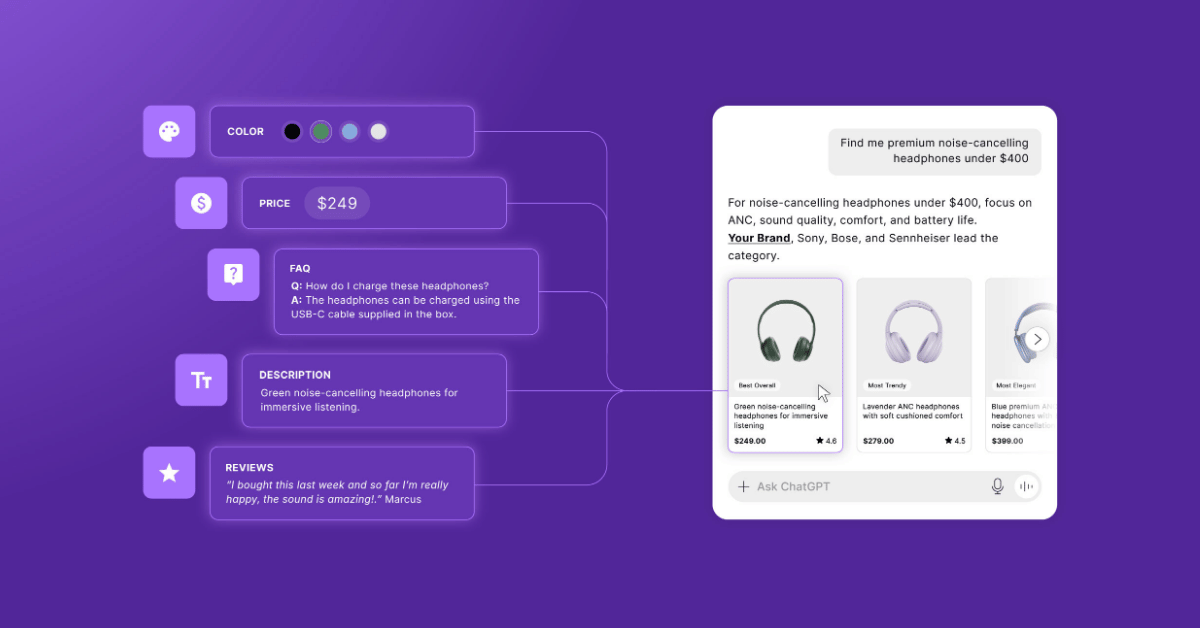
Sounds simple enough, right? Most brands already have a process and tools for Google Shopping, so it’s easy to assume the same setup will work for AI discovery. But it’s not that simple. AI platforms need richer, more complete product data so agents can understand when a product is the right answer for a shopper, not just whether it matches the words in a query.
Why your current GMC feed won’t cut it for AI discovery
In short, AI requires more data and richer data. For example, a standard Google Merchant Center feed runs on only a handful of required attributes including title, description, brand, link, an image link, availability, and price.
AI platforms, on the other hand, need more context. ChatGPT requires a broader set of fields with more optional attributes that help “enrich relevance and improve trust” like reviews, star rating, and return rate.
Google is moving the same direction. Google now offers conversational attributes in Merchant Center built specifically for their AI surfaces, like Q&A, document links, related products, variant options, and popularity rank.
Why all this extra data? Because AI doesn’t just show a product tile; it needs to answer shopper questions like:
- “Is this machine washable?”
- “Will this rug work outside?”
- “Does this plug into an outlet in France?”
- “Will this fit in a 28-inch cabinet?”
Your typical GMC feed can’t answer those questions. The answers live in reviews and Q&A on your site, but that data may never reach your PIM or feed management tool.
Your feed tool and PIM were built for a different job
Most e-commerce teams run some version of this stack:
- Product Information Management platform (PIM / PXM): Consolidates internal and supplier data and can also format and deliver catalogs to marketplaces and advertising channels
- Feed manager: Formats and distributes feeds to channels like Google Shopping, Amazon, and Meta
Data feeding into these tools comes from a medley of sources, including Enterprise Resource Planning (ERP) software, Master Data Management (MDM) technology, or even homegrown tools and internally managed databases.
Together, this stack keeps product information organized and helps teams syndicate it across traditional shopping channels. As agentic commerce has emerged, many tools have added AI as another destination. However, adding an AI channel to a feed manager is not the same as optimizing for AI discovery.
Two gaps tend to show up quickly:
- Manual feed generation: AI feed requirements are still evolving. If every new destination requires teams to map one feed specification to another by hand, every spec change becomes another operational burden.
- Limited or manual enrichment: AI platforms need product data that is deeper than what most feed tools already manage. Some tools can enrich fields, but the process often still depends on manual setup, prompt writing, field selection, or even connecting a separate LLM account.
The risk is real. If AI systems can’t find the right information, they won’t recommend your products — they’ll choose the answer that provides more context. And when your data is thin, or it conflicts with what they read elsewhere, they trust your brand less and point shoppers to someone else. Either way, the result is the same: less visibility, less traffic, and less revenue.
How to evaluate if your feed tool is fit for AI discovery
To understand whether your current setup can really help you show up and win in AI discovery, ask:
- Can the tool deliver feeds to the AI platforms where you need visibility?
- How much manual work is required to generate each AI feed? Will your team need to manually map your feed to every new platform format?
- Do you have the data needed for the fields AI platforms are requesting?
- If data is missing, how will you fill those gaps — with real product content on your site?
- Can you measure how AI feed optimization affects visibility, traffic, and revenue?
If the answer to any of these questions is unclear, your feed stack may be creating hidden work for your team and hidden risk for your business.
What Botify does differently
Botify’s AgenticCatalog is the intelligence layer that makes your product data work for AI systems. It sits alongside your existing PIM or feed management tool and handles what they weren’t designed for.
It starts with your existing feed, then uses Botify’s crawl data to fill the gaps. It enriches each product with the reviews, Q&A, and other on-site signals that AI systems need. It then optimizes text for AI consumption, generates feeds in the formats AI platforms require, and delivers them directly to OpenAI and Google.
Four things set it apart:
- Crawl-grounded enrichment. Enrichment is only as good as the data behind it. Most tools pull from your existing feed and ask generative AI to invent the rest. We enrich from real product data: reviews, Q&A, and crawl signals built on a decade of experience crawling enterprise sites.
- Built for AI, not bolted on. AgenticCatalog auto-formats feeds to OpenAI’s Agentic Commerce Protocol (ACP) and Google’s Universal Commerce Protocol (UCP). No manual field mapping, no writing your own enrichment prompts, no connecting your own LLM account.
- AI visibility you can act on. Most feed tools can’t show you when or where your products surface in AI answers, and unfortunately, you can’t optimize what you can’t measure. With Botify, you can see where your products show up across AI platforms, and where they don’t.
- Both sides of AI discovery. Pushing a feed is only part of what it takes to show up. AI also crawls your site and it checks what you push against what it reads. Your feed, the structured data (schema) on your pages, and your on-page content have to stay in harmony. When they disagree, AI trusts you less. Botify helps you optimize all three elements from one system.
Showing up means delivering a truly AI-optimized product catalog
Agentic commerce raises the bar for product data. If your current feed tool was built for yesterday’s shopping experience, it can still play an important role, but AI discovery needs more than distribution.
Brands need catalogs that can answer shopper questions, stay consistent with the site, adapt as platform requirements change, and drive real, reportable traffic and revenue. AgenticCatalog is the must-have infrastructure between your products and the AI commerce channels that are shaping the shopping journey as we speak. If you want to be found, understood, and chosen when shoppers ask AI what to buy next, it’s time to assess your tech stack and make sure it’s AI-ready.

.svg)


.svg)
